
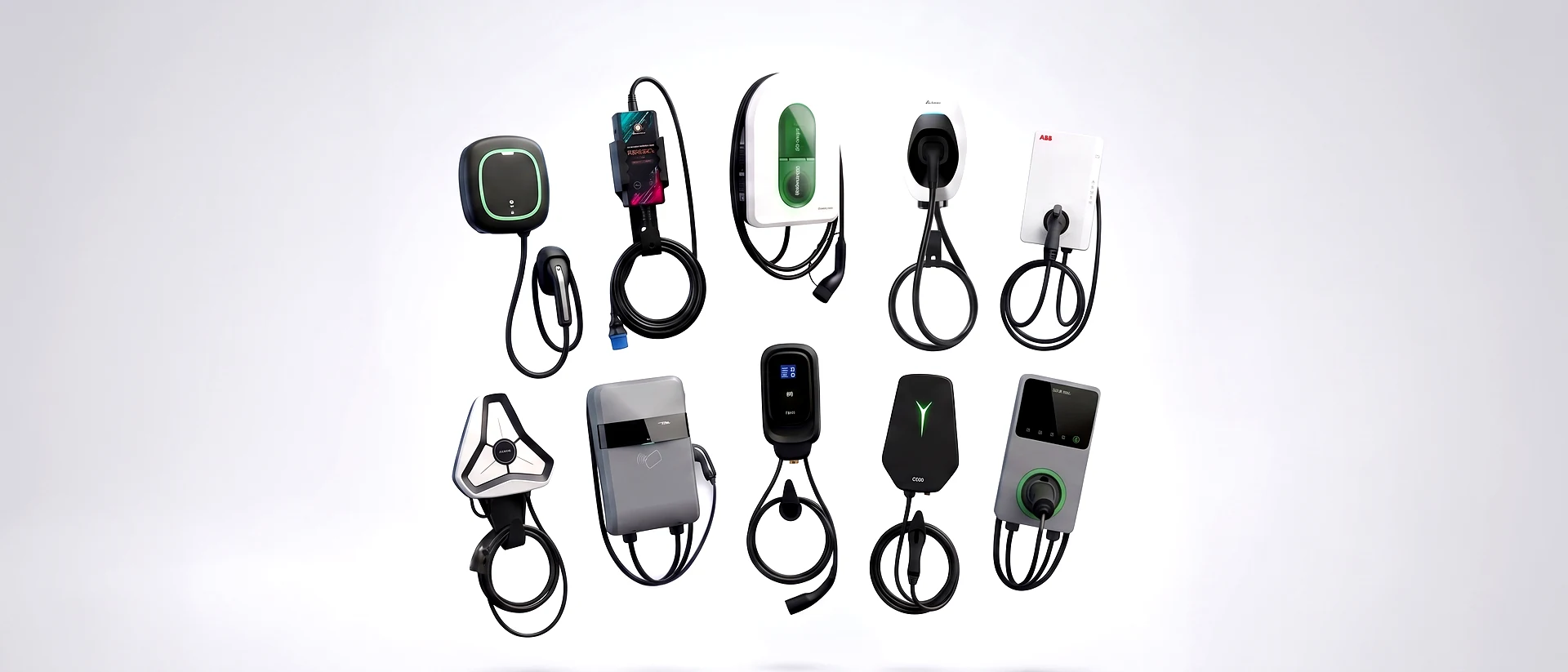
AC home chargers, sized right for your car
The standard for home charging in Singapore: 7.4kW to 22kW, wall-mounted and wired on its own circuit. Plug in overnight, wake up to a full battery — safely and affordably.
Ten LTA-approved AC brands, one honest recommendation










Everything you want from home charging
Full charge by morning
Plug in at night, wake up at 100%. A 22kW unit adds roughly 120km of range per hour — more than most people drive in a day.
Cheaper per kilometre
Charging at home on a residential tariff costs far less than public DC charging or petrol. Most owners recover the unit through the savings.
Smart control
App scheduling, off-peak charging, load balancing and usage tracking — depending on the brand you choose.
Certified & safe
LTA type-approved, installed by a Licensed Electrical Worker, TR25-compliant, with a Certificate of Fitness.
Choose the charger that fits how your site works
More power can mean more convenience — especially when charging is shared, time-sensitive or expected to grow.
7.4 kW
Single-phase AC charging
- Power & supply
- 7.4 kW • typically single-phase
- Typical charging time*
- About 7–10 hours for a 60 kWh battery
- Best for
- Straightforward home charging — apartments, HDB and condo lots, and daily overnight use
- Key benefit
- Simple, practical and cost-conscious
11 kW
Three-phase AC charging
- Power & supply
- 11 kW • 3-phase supply required
- Typical charging time*
- About 4–6 hours for a 60 kWh battery
- Best for
- Landed homes, small offices and shared lots where a useful step up in turnaround is needed
- Key benefit
- Versatile balance of speed and value
High-utilisation pick
22 kW
Three-phase AC charging
- Power & supply
- 22 kW • 3-phase supply required
- Typical charging time*
- About 2–3 hours for a 60 kWh battery †
- Best for
- Commercial sites, offices, condominiums, fleets, retail, hospitality and workplaces. Also ideal for landed homes with 3-phase supply
- Key benefit
- Faster turnover for shared charging, and a future-ready site
*Indicative times vary by vehicle battery size, state of charge, charger settings and vehicle acceptance rate. †A 22 kW charger still adds value for cars accepting less than 22 kW: it supports faster turnaround across users and helps prepare the site for future EVs.
Six of the ten, on jobs we finished
A specification sheet only tells you so much. This is the same hardware on real Singapore walls: one by a front door, one in a carport, one beside a lift lobby. Each is wired on its own protected circuit and handed over with a Certificate of Fitness.
Which one suits you depends on your car, your supply, and where the vehicle actually parks. That is what the survey is for, and it costs nothing.
- Ten LTA-approved AC brands
- 7.4kW to 22kW
- Own protected circuit
- Certificate of Fitness
Frequently asked questions
What size AC charger do I need?
Match it to your car's onboard charger and your home's supply. Most EVs and most homes are best on 7.4kW; three-phase landed homes may use 11kW or 22kW if the car supports it. We confirm the right size in your free site survey.
How long does a 7.4kW charger take to charge my EV?
A 7.4kW charger adds roughly 40km of range per hour, so it fully charges most EVs overnight (about 8–10 hours for a ~60kWh battery from low). You plug in when you get home and it's ready by morning.
Do AC chargers work with Tesla?
Yes. All our AC chargers use the Type 2 connector. Every EV sold in Singapore uses Type 2 for AC charging, including Tesla, BYD, Hyundai, Kia, BMW and Mercedes. You do not need a Tesla-only charger.
Do I need three-phase power for a home charger?
No. Single-phase 7.4kW is enough for most owners and is what most HDB and landed homes have. Three-phase (11kW/22kW) only helps if your car accepts that speed — we check this before recommending anything.
How much does an AC charger cost in Singapore?
It depends on the brand and power you choose, how far the cable has to run, and any electrical work needed. That is why we do not publish flat prices. You get a clear quote for your own site after a free survey, with nothing hidden. An LTA registration fee applies to AC chargers.
Can I install an AC charger at an HDB or condo?
Landed homes are the simplest. In HDB blocks and condos, charging usually happens at shared chargers in the common areas, and the property decides the rules. We will tell you honestly what is possible where you live.